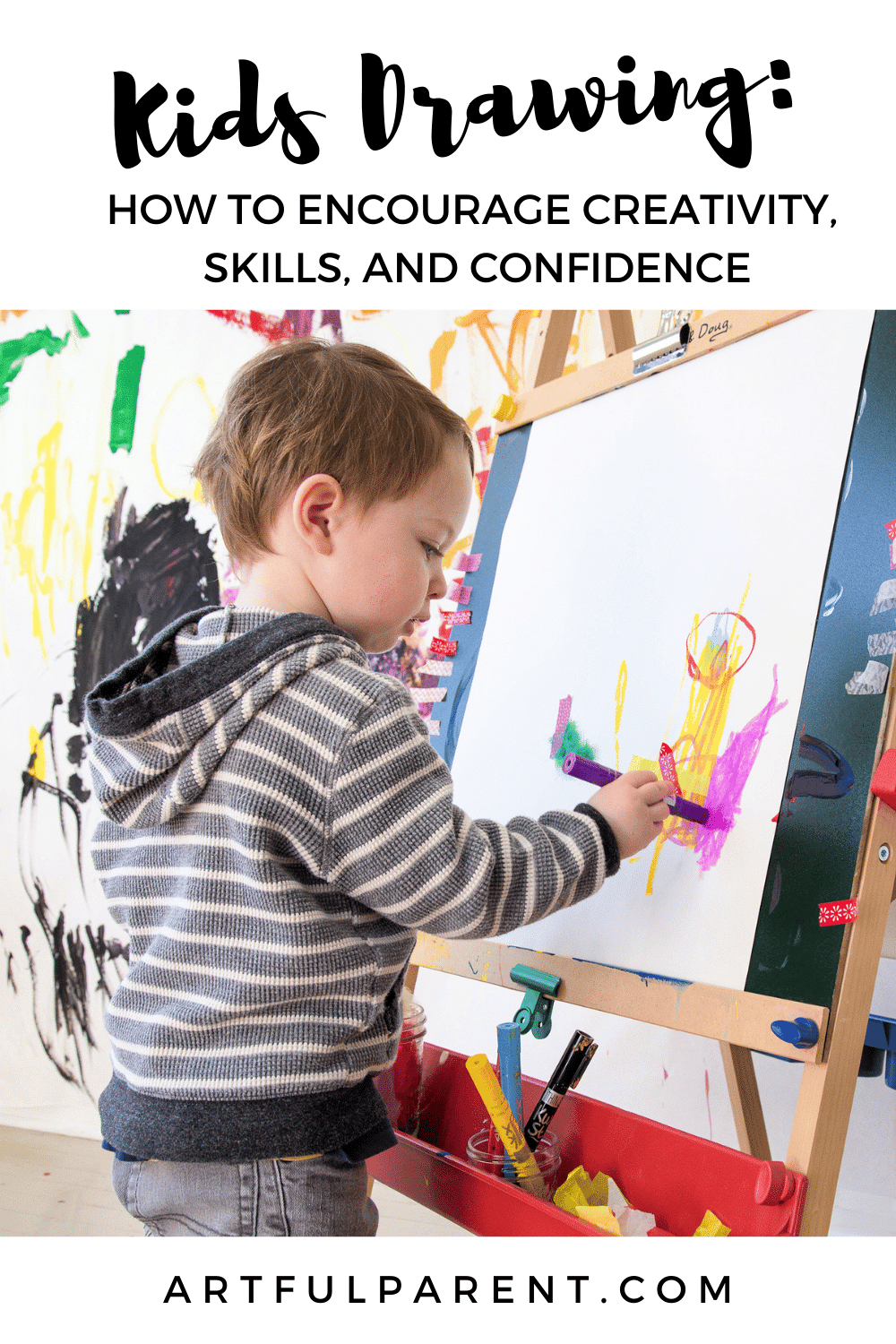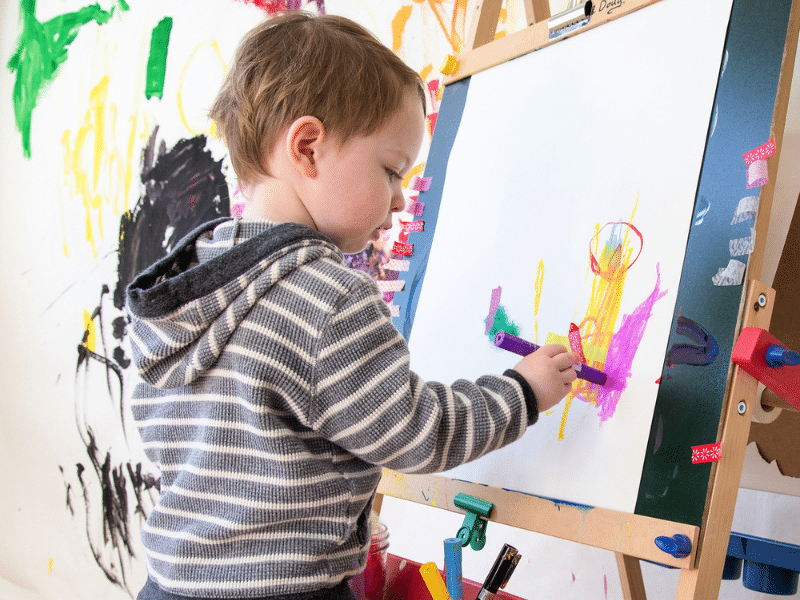


Kids drawing should be fun and process-oriented. Learn how to encourage drawing skills, confidence, and creativity in young children.
Updated December 2025
We regularly receive questions about kids and art and we wanted to address a question regarding kids drawing:
The Artful Parent
Family-life ideas and sharp reads, in your inbox.
I can’t draw very well, and really don’t want [my daughter] to take after me. Would you suggest an art class as a good idea for a 3 year old? There are a few in my area that look fun.
The short answer?
No. You don’t need to send your three year old to an art class to learn how to draw.
(Note: There are other reasons you might choose to take your young child to an art class, and we will get to those in a minute.)
We also have a longer answer that addresses:
- whether to teach drawing skills to a 3 year old
- whether to take your 3 year old to an art class
- lack of drawing skills and possibly creative confidence for the parent
- worry about transferring that lack of drawing skill (possibly confidence) to the child
Drawing Skills & Creative Confidence In Young Children
There is a lot that goes into drawing ability. Self-confidence is one of them.
Believing that you can draw, as well as enjoying the act of drawing, are as important – no, MORE important – than technical drawing skills.
We really believe that.
Our first and most important suggestion is to help your daughter hold on to her self-confidence. In art specifically, but also in herself in general, and her enjoyment of art.
How? Here are some ideas to help you.
1. Don’t ever denigrate yourself or your own drawing abilities
Show her that you have confidence in yourself and are at peace with your abilities (fake it ‘til you make it, baby).
If you sit down and draw beside her (and we think you should at least once in a while!), don’t say, “I can’t draw.”
If you don’t feel like you can draw a realistic elephant, that’s okay! Realism is overrated! Or, if you don’t think so, pretend you do for a little while.
Draw a completely abstract elephant in bright colors. Or just draw abstract, period. Doodle squares, circles, spirals, hash marks, letters, and whatever else you think of across the page.
Enjoy the process. Keep your pen moving. Perhaps try for a design or a mandala.
But don’t utter the words, “I can’t draw” in front of your child. Children learn by example.
2. Be conscious of how you talk to your child about the art he or she makes
Don’t just say, “that’s pretty.” Talk about the marks she is making on the page or the colors she is using: “Wow! You really worked hard on that!”
A great default is to ask children to tell you about their artwork.
If your child is a young three, she might not be assigning meaning to her art yet (or then again, she might). As she nears four, she will likely become more elaborate with the stories that go with her art.
3. Make art fun and exploratory
Keep your child’s art activities as process-oriented as possible at this age.
Try not to expect particular outcomes, but rather, encourage her to explore the following:
- art materials (paints, crayons, shaving cream, etc)
- ideas (big/small, themes from her life, similar and contrasting colors)
- techniques (watercolor resist, splatter painting, shaving cream marbling)
Introduce new materials and techniques, but also stand back and let her explore art on her own, in her own way.
Try giving her freedom to explore during projects that you set up for her. And also try to have some art materials accessible to use any time she likes. This could be an art caddy with markers, crayons, scissors and tape near the kitchen table. It could also be her own dedicated art space with a table or easel and a wider range of kids’ art supplies.
4. Keep art activities developmentally and age appropriate
Instead of teaching a young child “how to draw”, you can guide him or her through the occasional observational drawing exercise and preferably in a way that encourages observing as much as drawing. Or try this back and forth drawing activity with her! The most important thing at this age is to encourage open-ended exploration of art materials, self-confidence, and enjoyment in art and learning.
Let her go through the normal developmental stages in drawing and art at her own pace.
Reasons To Try Other Art Classes
What about art lessons and art classes for young children?
An art class for young children may be a good idea for reasons other than learning how to draw.
- It might provide you with ideas and instructions for more art activities to do with your daughter at home.
- It might expose your child to more materials and activities than she has at home.
- You and your child might enjoy the social aspect of the art class.
- The art class might provide messy art experiences that you might not feel comfortable providing at home.
If you want to try an art class with your young child, we would suggest one that is focused on age-appropriate, process-oriented art.
Reasons To Try Art Classes For Adults
Would you like to improve your own drawing skills?
If you’d like to learn how to draw better or more confidently, consider taking that drawing class yourself (well, one for adults anyway). There are classes oriented towards all levels of drawing ability.
We have heard good things about the book, Drawing on the Right Side of the Brain by Betty Edwards. There are some pretty dramatic examples of before and after drawings done by adults who went through the exercises in the book or took the class. (Buying through this link may earn us a commission, at no extra cost to you.)
To recap, our suggestion for kids drawing is: focus on process-oriented art, build self-confidence, keep art fun, and don’t ever say, “I can’t draw.” If you choose an art class for your child, do it for the right reasons. And make sure the class is appropriate for your child’s age and developmental stage.
More Drawing Ideas for Kids
- Drawing for Kids: Tips for Encouraging the Reluctant Artist
- 12 Kids Art Games for Fun and Creativity
- Creative Drawing Activities for Kids
- How to Inspire Your Kids with Creative Drawing Prompts
- 16 Printable Art Activities for Kids
- DIY Art Activity Pages for Kids